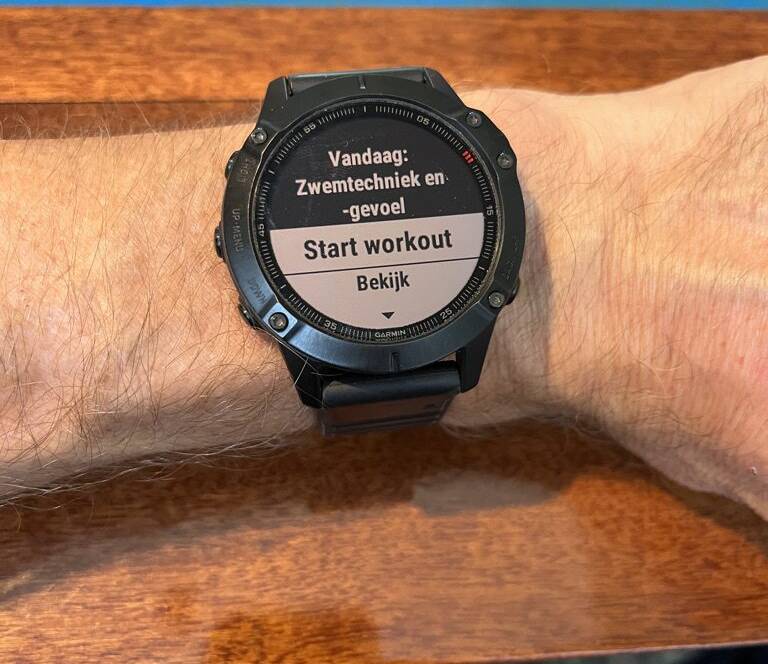
It’s a bit fuzzy, every now and then, working with zones. For example, on Strava you often see cyclists talking about a lap in D1 or D2, runners talk about a tempo run, others use zone 1-x and so on. But what are they talking about, those zones and intensity of training? Let me pretend to be a teacher and explain it in such a way you’ll learn theory from practice. Or as Davydov writes about ‘climbing from the abstract to the concrete’ (just think about that for a moment, or read here). We are talking here about the concept of ‘training zones’ that is used and understood in different ways. According to Davydov, this is because “a concept is expressed in movement, not in fixed definitions” (nice huh, says Engeström, 2020, p.34).
Below is an example of determining my own threshold. Below the video the further explanation.
Anyway, I use data from a ‘random’ athlete and show what zones can be and how to divide the zones with your threshold value. We call the athlete Senna. We assume heart rate zones. You could also use tempo zones and power zones. The idea is the same, the difference is in the accuracy. Tempo is more accurate (in equal conditions) than heart rate, power is again more accurate than pace, especially since the conditions do not matter.
Senna has been running fanatically for a while, has also bought a bike in the lockdown and is thinking about going do a triathlon. She wants to train more seriously and now collects all kinds of data through her sports watch, but doesn’t know what she can do with it. Her Garmin watch gives her all kinds of unsolicited advice, which she doesn’t really know what it means. The advice Garmin after 40 km of cycling: advice recovery 11 hours and see the rest below.
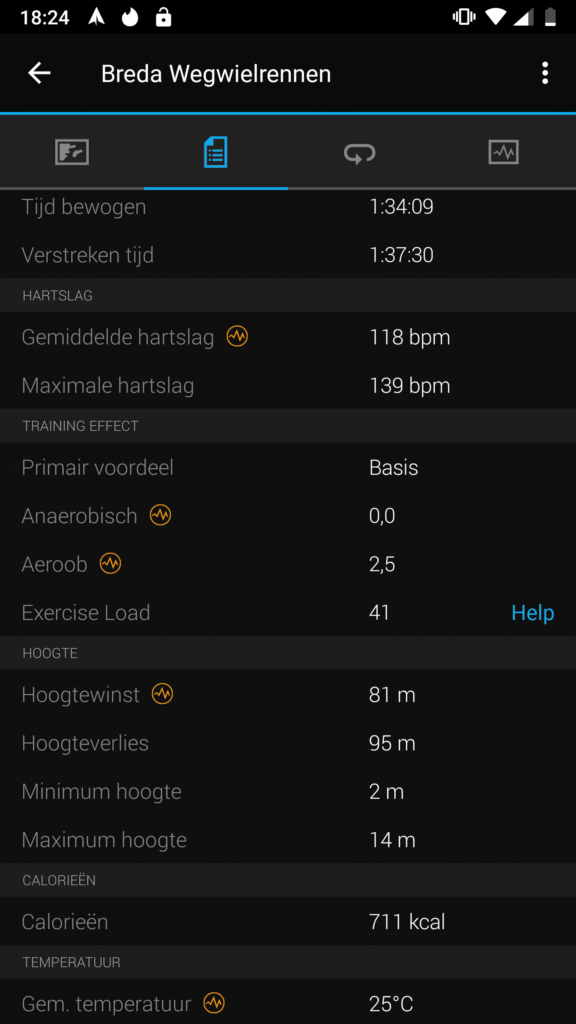
Aerobic, anaerobic, those are physiological terms for which energy system your body uses. It also says something about the intensity of the training. (Sot more precisely, aerobic means that you convert energy with oxygen, anaerobic without oxygen. Aerobic workouts are lower in intensity; energy conversion with oxygen is slower.)
If you train purposefully, then every training has goals and training programs have a goal. Depending on this, training has a targeted intensity. The more precisely you would measure and know it, the more precisely you (probably) achieve your goal.
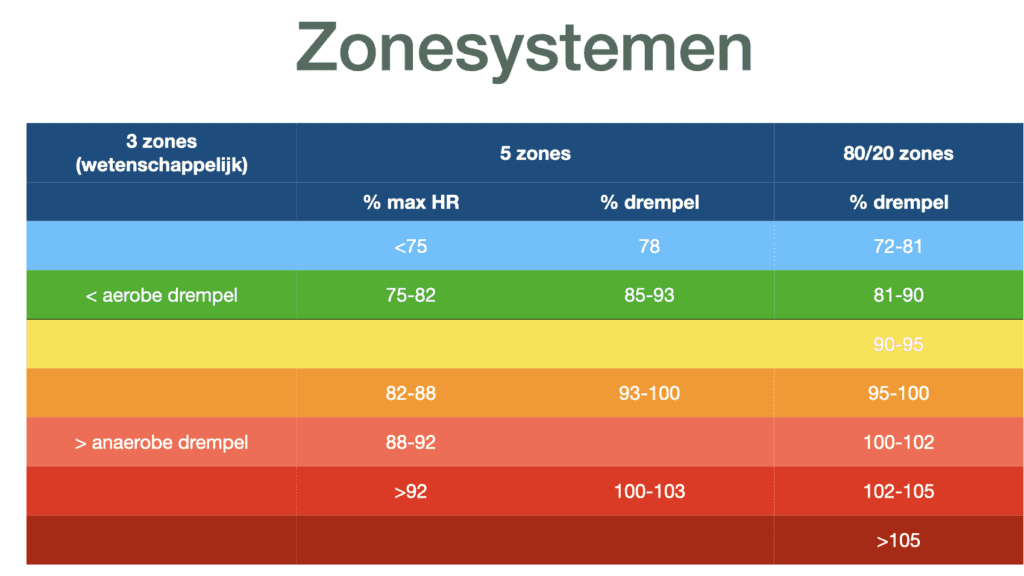
Intensity of a (part of a) workout is indicated for most athletes in zones. Zone layouts come in many shapes and sizes. And it does matter for the zones what approach to training you use. There are also various theories about that. I follow the theory of ‘polarized training’ and have once joined 8020Endurance as a coach, on which my training and training programs were also based, when I made them myself (before AI). The idea is that you do (about) 80% of the workouts at low intensity (zones 1 and 2) and 20% in the high (3,4,5). The whole system will be explained elsewhere on this site (the explanation of 8020Endurance itself can be found here). Simply put, it means that you do a lot of low-intensity workouts to recover faster. The high-intensity workouts must then be really high for optimal results. The workouts that bother you just too much, but little effect – exactly the workouts that come with scoring Strava segments and KOM’s – they avoid as much as possible. In any case, the layout of the zones is also related to that idea behind the trainings.
Devices usually have a fixed zone system. For example, Polar has a five-zone system, Garmin has six, 8020 uses seven zones. Scientists talk about only three zones. That’s because scientists rely on what can be measured and those are two values (the aerobic and anaerobic threshold) and so there is a zone below, between and above.
The algorithms of devices and apps use rules of thumb to determine how the heart rate zones are classified. The six zones that Senna Garmin has set can be seen on the right side of the image below. Garmin calculates it based on resting and maximum heart rate that Senna has already recorded with her watch.
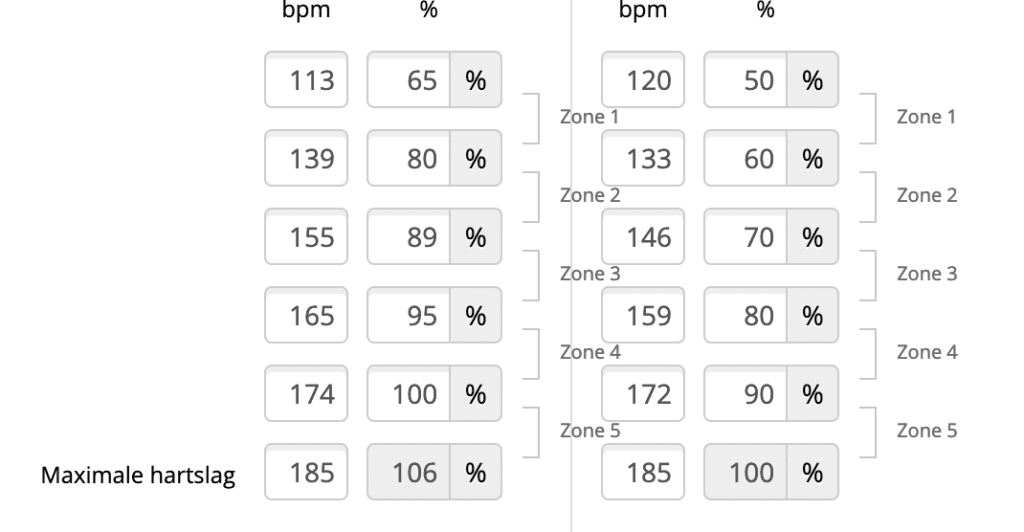
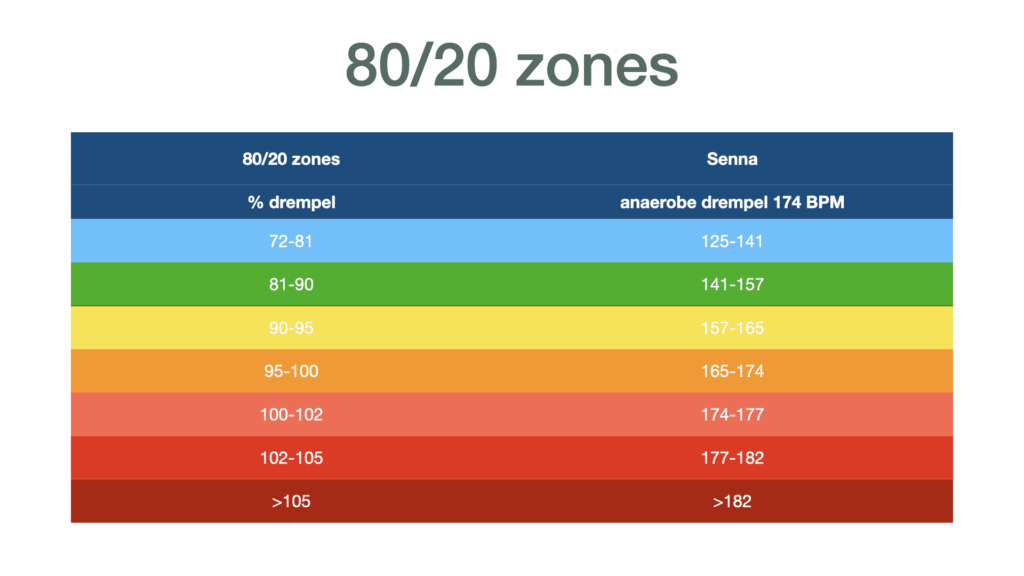
Suppose Senna wants to do a standard distance triathlon and maybe more. And suppose I were to coach her, I would use the 8020 method. As mentioned, most training sessions will be in zone 1 and 2. Only then I use not six, but seven zones. And we determine the zones not based on resting and maximum heart rate, but on the basis of the threshold value: the anaerobic threshold. In Garmin they call it the lactate threshold. It is for Senna 174 Beats Per Minute (BPM). On the left in the picture above, see the six zones that Garmin chooses based on the lactate threshold. If we make a division of this into seven zones on the 8020 method, you will get the table below.
How do you determine those threshold values? Ideally, you do this with blood samples during a test, or otherwise with a test with a measurement of your exhaled air. But it can also be easier, but a little less precise. As an athlete who just wants a little more, that’s enough, because that immediately inhibits the intensity of the workouts and that in turn prevents injuries. What you do is, walking or cycling, after a warm up of about 10 minutes, to go as fast as you think you can last a maximum of half an hour. Then keep an eye on your heart rate and as soon as it stops rising, that point is your threshold. So you don’t really have to hold on for 30 minutes, because after about 20 minutes your heart rate won’t rise anymore. If you already have a lot of data in your training app, the algorithm will determine it just as precisely, just as not on the 8020 method. Now that you know your threshold value and your zones, you can start training more accurately on intensity. Good luck!