So, there you are, about four weeks into your Humango training plan, listening to Hugo and getting a hang of it. Fun right? Well, sure, but there is more to come. Does the workout intensity feels a bit low? How do you get the exact prescribed heart rate? As coaches we get these questions often when athletes start their new structured and personalised journey to a big challenge. The answer often is we need to do some testing.
Coach Pav (the guy from the workouts) and Martijn (from the Banananshop) answer the questions they frequently got from their athletes.
Testing is that still needed with all the AI in Humango?
Martijn: Yes, it is, Hugo needs data. And the better the data, the better the plan, the workouts and the intensity zones.
Pav: Indeed. Better data is crucial to getting the best plan and using repeatable protocol and conditions will make tracking this a lot easier. While it is usually clear to see you are making improvements in training, having a set protocol, conditions, and form value, makes tracking exact improvements much easier.
But I have uploaded all my data from the last 3 months to Humango, why isn’t that enough?
Martijn: It is enough for now, to start, but we want more to improve efficiently. You want progression and may even feel fitter already, right? And you want to keep that feeling.
So, to understand how a dynamic training plan works, i.e. how to improve your fitness, we need to explain a bit about how training works. The science.
Efficient and effective training basically means training the exact energy systems of your body, that you need for your challenge. Those systems are divided by thresholds and thus define the training zones you can see in your dashboard. As a result of training the thresholds change, especially the pace and power thresholds (TPA and TPO in Humango). That’s progression. To keep training the right energy systems (the right training zones), we need to verify the thresholds now and then (see also my videos on the matter here, in Dutch)
Pav: in addition, you can use HumanGO’s own testing protocol to get near lab quality results to set your training zones. For example, using fatmax to set the endurance zone, rather than just a % of threshold, or a more accurate reflection of your VO2Max for your high intensity intervals.
So, if we have the tests, why then also have the Hugo Dynamic value?
Pav: Some people are bad testers, or you have a bad day during the repeatable testing. While we as coaches would look to encourage clients to work on performance anxiety, Hugo isn’t quite that evolved, at least yet! You could also be new to structured training or returning after a long layoff, using trainign data to set intensity can be safer for these people.
Martijn: I like to see the Hugo dynamic value as the daily step on your scales, the tests as the validated measurement at the fitness centre.
The testing can thus be seen as a point to work towards. This way it works psychological as well: to train towards a test is like working towards the presentation of the update of your ‘project’. The project obviously is the a-race or your challenge.
I see some values change, but other values don’t, why is that?
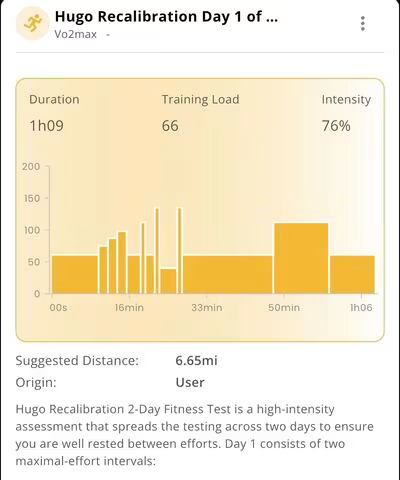
Pav: the Hugo Recalibration testing can test Heart Rate, Pace and Power, depending on what you use.
Pace and power will change more than HR, since HR is more stable over time. Once fit, the max and threshold HR will be stable. > Pace and Power don’t it’s the power/pace-HR relation that matters…
Martijn: A colleague of ours explained the difference in use of heart rate or pace/power as the difference between the temperature of a car, the speed (pace) and the actual input (power). The first two are dependent on the latter and have a less fixed limit.
How does it adjust schedule on Hugo dynamic, and when Test is done?
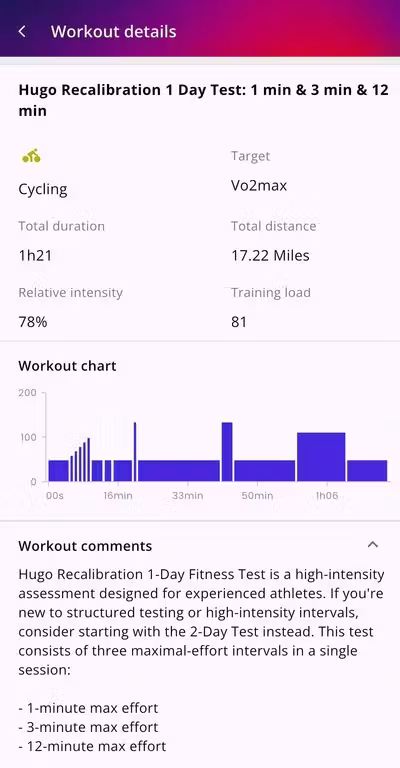
Pav: All workouts are changed immediately after testing or on a weekly basis for Hugo Dynamic, and no replan is required to see the changes.
I hate the test, even must puke often …
Martijn: Many do. See the tests therefor also as a mental test: how good are you at going at max pace or power? Or even better, estimate your improvement over time, and make it a game how well you estimated. Bonus points for puking, since then you were able to go all the way! Just like in the race. (Just kidding.)
Pav: Be careful though not to overestimate and then start too hard and not be able to finish the test. Aim to perform steady, prepare well, and make every test in the same conditions, or as close as possible. If you have tested before, you already have a good idea of what you can achieve, or you can see some data on this in the Peaks stats in the Progress screens in app.
Martijn: And remember, the test is also ‘just another’ workout. One with a high intensity though. With this mindset the test is (also) training, and meanwhile you are training to the test.
Pav: In between the tests Hugo keeps monitoring the progression and calculates the progression too, so the training is also the testing.
Watch: Hugo Metabolic Test